Trifecta Wheel Bets: UK Tricast Costs, Formulas, and Part Wheel Strategy
 Available in US
The call came through at Ascot in 2019. A punter had landed a tricast on a Saturday handicap, and the dividend was causing confusion at the payout window. His ticket showed a wheel structure nobody in the queue had seen before. Three horses keyed across different positions, wheeling the rest of the field into third. The return exceeded £4,000 from a £36 outlay. What looked exotic to the crowd was simply arithmetic applied with precision.
Trifecta wheels occupy a peculiar space in UK betting culture. Most punters understand the tricast concept well enough: pick horses to finish first, second, and third in exact order. Fewer grasp how wheel structures can reduce costs while maintaining strategic coverage. The mathematics scales aggressively compared to exacta wheels. Adding a third position multiplies combinations in ways that punish careless construction and reward disciplined handicapping.
Tote+ Tricast data reveals a compelling edge for those willing to learn the mechanics. The pool-based tricast beats fixed-odds bookmaker tricasts 77% of the time, delivering 50% more value on average. That margin dwarfs what most betting strategies promise. Yet tapping into it requires understanding not just which horses to select but how to structure those selections efficiently across three finishing positions.
I have built trifecta wheels on everything from maiden races at Wolverhampton to the Grand National’s 40-horse cavalry charge. The core principles remain constant even as field sizes fluctuate wildly. What follows breaks down those principles into formulas you can apply, examples you can follow, and strategic frameworks that prevent the combinatorial explosion from consuming your entire bankroll.
Understanding Trifecta and Tricast Terminology
Terminology creates unnecessary confusion in this space. American handicapping material calls it a trifecta. British bookmakers and the Tote call it a tricast. Same bet, different labels inherited from different racing cultures. You are predicting which three horses cross the line first, second, and third, in that precise order.
The tricast rewards precision more harshly than the forecast. Miss the winner and your ticket is void regardless of how accurately you predicted second and third. Nail the winner but reverse second and third, void again. Every permutation matters, which is precisely why the payouts can reach eye-watering levels when outsiders fill the frame.
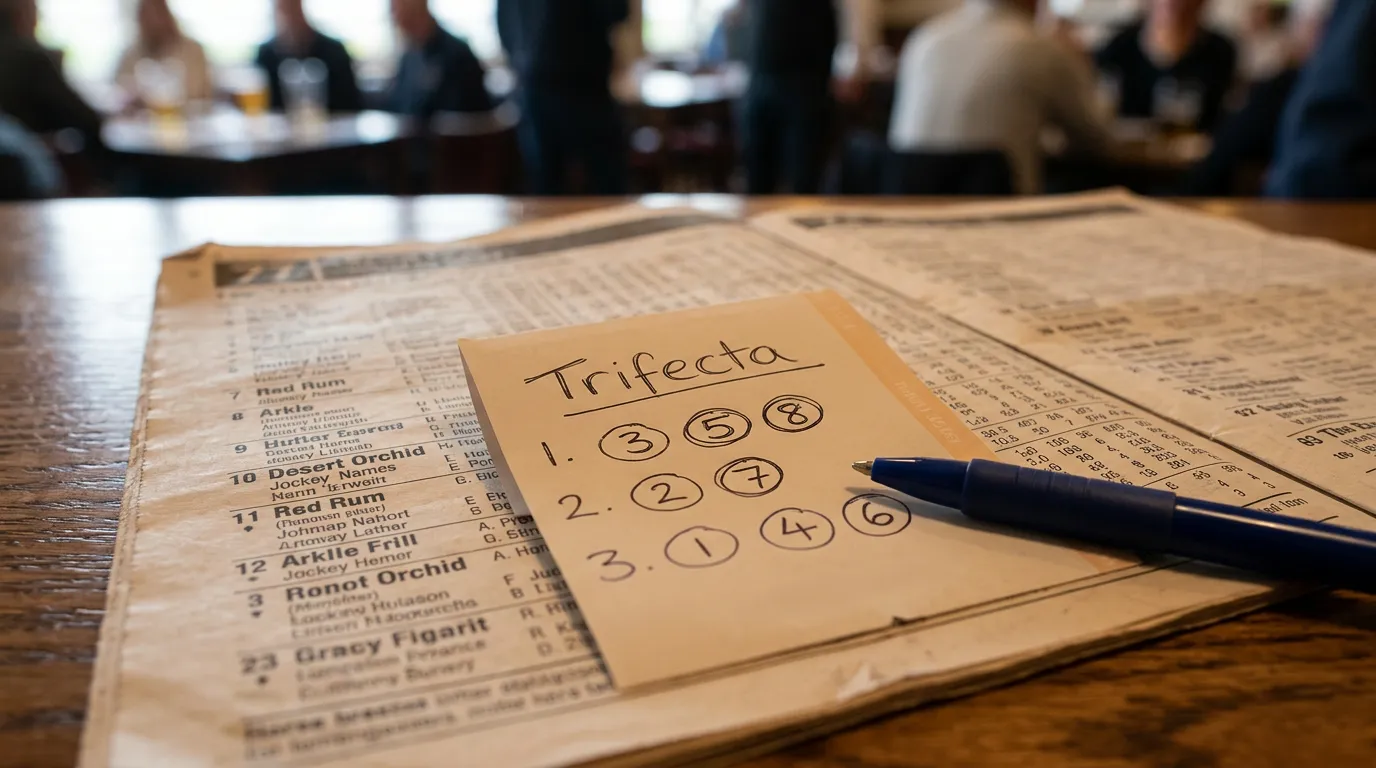
A straight tricast means selecting exactly one horse for each of the three positions. Horse A to win, horse B second, horse C third. One combination, maximum precision required, maximum potential return. The odds of landing a straight tricast in competitive fields hover somewhere between ambitious and audacious.
Wheel structures introduce flexibility. Rather than committing to single horses in each position, you can anchor one or more positions with key selections while wheeling other positions through multiple contenders. The trade-off is straightforward: more combinations increase your chances of holding a winning ticket but divide your stake across more potential outcomes.
Three primary wheel configurations exist for trifectas. The single-key wheel anchors one horse in one position and wheels the other two positions through selected fields. The double-key wheel anchors two horses in two positions, wheeling only the third. The part wheel lets you specify different horses for each position without committing to a single key. Each configuration suits different race scenarios and conviction levels.
Understanding which configuration matches your handicapping situation determines whether the trifecta wheel amplifies your edge or simply multiplies your exposure to randomness.
Full Trifecta Wheel Mathematics
The jump from exacta to trifecta mathematics catches many punters off guard. Adding one position does not simply add combinations linearly. It multiplies them.
A full trifecta wheel with one key horse in first position, wheeling the entire remaining field through second and third, produces combinations according to this formula: (n-1) x (n-2), where n equals total runners. The key horse cannot fill second or third, hence subtracting one. The horse filling second cannot also fill third, hence subtracting two.
Run the numbers on a ten-horse field. Key one horse to win, wheel the other nine through second and third. Combinations equal 9 x 8 = 72. At £1 per combination, your full wheel costs £72. Compare this to the exacta wheel on the same field: only 9 combinations at £9 total. The trifecta wheel costs eight times more for that single additional position.
Twelve-horse field with a single key? Combinations balloon to 11 x 10 = 110. At minimum stake, that is £110 committed to a single race. The cost escalation explains why full trifecta wheels rarely make strategic sense outside of specific high-conviction situations.
Keying in second position follows identical mathematics. Your key horse cannot win or finish third, so you wheel all others through those positions. Ten runners, key in second: 9 x 8 = 72 combinations. The formula does not care which position holds the key.
Keying in third position maintains the pattern. The horse anchored in third cannot also win or finish second, leaving the same 72 combinations in a ten-horse field.
Where the arithmetic shifts is with double-key wheels. You anchor two horses in two specific positions, wheeling only the third. Formula simplifies to: n – 2 combinations. Ten horses, keys in first and second, wheel third: 10 – 2 = 8 combinations. Suddenly the trifecta wheel cost resembles an exacta wheel cost. The price is sacrificing flexibility in two positions rather than one.
Full wheels across all three positions without any keys produce the maximum combinations: n x (n-1) x (n-2). A ten-horse field boxes to 720 combinations. Nobody with functioning risk management wheels trifectas this way. The numbers exist to illustrate why keying positions is not optional but mandatory for sustainable exotic betting.
Part Wheel Position Strategies
Full wheels treat all non-key horses as equally likely to fill the wheeled positions. Part wheels acknowledge reality: some horses have virtually no chance of finishing in the frame while others clearly belong there. Strategic construction requires assigning horses to positions based on their likely finishing range.
Start with the fundamental question: which horses can win this race? Not which horses you want to back or which horses offer value at their price, but which horses possess the ability to finish first. Be ruthless. In most UK races, the number of realistic winners falls between two and five regardless of declared field size.
Favourites win 30-35% of British races. That leaves substantial space for non-favourites, but the winners still cluster among the top five or six in the market. If you cannot articulate why a horse at 25/1 might win, that horse belongs out of your first position entirely.
Second position offers more latitude. Horses that lack the tactical speed or class to win can still finish with purpose when the pace collapses or the winner kicks clear. Your second position candidates should include obvious frame horses who consistently hit places without threatening winners.
Third position casts the widest net. Here you can include horses whose style suits running on into tired rivals, horses drawn to benefit from a particular pace scenario, and improving types whose ceiling remains undefined. Third is where longshots earn their place in wheel structures.
A practical construction might look like this: three horses wheeled in first position, five horses in second position, eight horses in third position. Combination count: 3 x 5 x 8 = 120. Still expensive, but now every combination represents a handicapping opinion rather than a mechanical coverage of all possibilities.
Tighter constructions prove more sustainable. Two horses in first, three in second, five in third. Combinations: 2 x 3 x 5 = 30. At £1 per combination, total stake reaches £30. The tradeoff is clear: miss with your winner selections and the entire wheel fails, but land a winner and you have meaningful coverage of likely minor placings.
The configuration that suits your betting depends on where your handicapping skill concentrates. If you excel at identifying winners but struggle to rank the minor placings, use fewer horses in first position with wider coverage below. If you consistently spot frame horses but find winner selection volatile, consider keying a likely frame horse in second or third while wheeling potential winners above.
Flexibility is the point. Part wheels let you express nuanced views across three positions rather than forcing binary key-or-wheel decisions.
How Field Size Affects Costs
Field size determines everything in trifecta economics. The same wheel structure that costs £20 in a seven-horse field might cost £200 in a fifteen-horse handicap. Understanding this scaling protects you from inadvertently over-committing to races where the mathematics work against sensible staking.
Average field sizes in UK racing have compressed over recent years. Flat racing averaged 8.9 runners per race in 2025, down from 9.14 the previous year. Jump racing fell more sharply to 7.84 runners from 8.49. These averages mask significant variation between card types and meeting quality, but they establish a baseline for cost expectations.
At 8 runners with a single key and full wheel through second and third: 7 x 6 = 42 combinations. At 12 runners with the same structure: 11 x 10 = 110 combinations. The four additional runners nearly tripled your combination count. This non-linear scaling is the core challenge of trifecta wheel management.
Smaller fields offer structural advantages for wheel construction. A six-runner novice chase with one dominant favourite creates a clean double-key opportunity. Key the favourite in first, key your second pick in second, wheel the remaining four in third. Total combinations: 4. At £5 per combination, total outlay hits £20. If any outsider scrambles into third behind your two keys, you collect.
Larger fields demand restraint. A sixteen-runner Saturday handicap at a premier meeting might feature ten horses with legitimate claims to finish in the frame. Attempting to cover all ten across three positions while maintaining any key structure produces unmanageable combination counts. The discipline shifts from how much can I cover to which horses can I confidently eliminate.
Premium fixtures actually offer some relief here. The average field size on Flat Premier meetings reached 10.97 runners, but these fields typically feature deeper form and clearer class distinctions. Separating horses by likely finishing position becomes easier when quality gaps exist within the field.
Tactical advice: calculate your combination count before finalising selections. Use the formula first, then adjust your horses to match your budget rather than selecting horses first and hoping the cost falls within range. If your initial construction produces 80 combinations but your budget supports 40, you must cut horses from at least one position. Make those cuts based on handicapping rather than random elimination.
Field size also affects dividend expectations. Larger fields produce higher average tricast dividends because more combinations fail. If you do construct a wheel on a big-field handicap and land the tricast, the return typically justifies the higher combination count. The question is whether your edge in those races supports the increased exposure.
Tote Tricast Value Analysis
Every time I see a punter place a bookmaker tricast when the Tote pool is available, I wince. The data could not be clearer: Tote+ Tricast beats fixed-odds bookmaker tricasts 77% of the time, generating 50% more value on average. That edge compounds dramatically over any meaningful sample of bets.
Fixed-odds tricasts use formulas based on starting prices to calculate dividends. These formulas attempt to model what a fair payout should be given the odds of each horse. The models consistently undervalue unexpected outcomes, precisely the scenarios where trifecta wheels generate their largest returns.
Tote tricasts operate on pure pool mechanics. All stakes enter the pool, the Tote deducts its 25% commission, and the remaining money divides among winning tickets. No formula intermediates between money in and money out. When public money concentrates on obvious combinations that fail to materialise, winning tickets on alternative outcomes receive disproportionately large payouts.
The Tote+ guarantee eliminates downside risk in this comparison. You receive either the Tote dividend or the Computer Tricast formula payout, whichever is higher, plus a potential enhancement. The guarantee establishes a floor while the pool mechanics create upside. Rational exotic bettors route tricast wheels through the Tote by default.
Where does the 50% average edge come from? Largely from races where the finishing order defies market expectations. Heavy favourite finishing third behind two unconsidered outsiders. Market movers flopping while morning prices rally. The CSF-style formulas struggle with these disruptions because they weight starting prices heavily. The Tote pool simply divides money among whoever holds winning tickets.
Practical implications follow. Trifecta wheels targeting chaotic outcomes benefit most from Tote routing. Large-field handicaps where form offers limited guidance. Soft ground jumps races where stamina tells late and front-runners tire. Any race where you anticipate the public concentrating money on predictable combinations while you spread coverage more broadly.
Pool size matters for dividend stability. Major meetings generate large tricast pools where individual bets barely influence final dividends. Smaller meetings with thinner pools can produce volatile swings. The Tote+ guarantee protects against the worst outcomes, but checking pool size before finalising your stake helps calibrate expectations.
Festival Racing in Practice
Festival meetings present trifecta wheel opportunities unlike anything else on the calendar. Fields swell, class horses congregate, and pool sizes reach levels where dividends stabilise around genuine market-clearing prices. Cheltenham in March and the Grand National meeting at Aintree in April offer the highest-stakes wheel construction exercises of the year.
Consider the Grand National itself. Maximum field size of 40 horses makes it the largest field in jump racing. A full wheel with one key and all others in second and third would produce 39 x 38 = 1,482 combinations. Nobody constructs that wheel. Instead, the race demands aggressive pruning based on clear eliminating criteria: horses with inadequate stamina records, horses facing trip questions, horses with poor records at Aintree specifically.
A realistic Grand National wheel might include five horses with genuine winning credentials in first position, eight horses with solid each-way profiles in second, and twelve horses capable of filling third if they jump round safely. Combinations: 5 x 8 x 12 = 480. Still substantial at £480 minimum, but manageable for serious exotic bettors who view the race as their marquee annual play.
Cheltenham handicaps offer more contained structures. The Pertemps Final typically draws around 20 runners. Form analysis can usually isolate six or seven horses with realistic winning chances based on their qualifying form. A wheel with four horses in first, six in second, and ten in third produces 240 combinations. At £1 per combination, you are committing £240 to a single race, but the potential tricast dividends in a competitive 20-runner handicap justify that exposure when your selections hit.
Festival racing also rewards timing awareness. Pools grow substantially on the day as casual punters pile in. Early indicative dividends can look dramatically different from final settlements. I place my tricast wheels no earlier than 30 minutes before post time, giving the pool time to absorb the bulk of public money while preserving flexibility to scratch if late market moves invalidate my construction.
One structural advantage at festivals: the percentage of uninformed money increases. Casual bettors attracted by the spectacle often back combinations based on names, colours, or tips from newspapers rather than systematic handicapping. Their losing stakes flow into the pool and eventually into the pockets of bettors who constructed more analytical wheel structures. The bigger the pool and the more recreational money it contains, the better the expected value for disciplined wheel constructors.
Build your festival wheel playbook in advance. Know which races draw the fields that suit your handicapping style. Allocate a specific festival bankroll rather than playing opportunistically. Treat the meeting as a campaign rather than a series of disconnected races. The profits from one well-constructed wheel can fund an entire season of exotic betting at smaller meetings.
Keeping Your Trifecta Budget Under Control
Champion trainer John Gosden put it bluntly when discussing the economics of modern racing: an industry contributing £4 billion to the economy faces pressure from all sides, including taxation that threatens to squeeze margins further. For punters, the parallel is clear. Capital is finite. Trifecta wheels that consume disproportionate bankroll shares leave nothing for subsequent opportunities.
Start with a maximum race allocation. I never commit more than 5% of my exotic betting bankroll to a single trifecta wheel regardless of conviction level. If my bankroll stands at £2,000, my maximum wheel stake is £100. This constraint forces me to construct wheels that fit within budget rather than building ideal constructions and hoping the maths works out.
Work backward from your stake limit to determine feasible combinations. A £50 budget at £1 per combination supports 50 combinations. That structure might be 2 x 5 x 5 or 5 x 5 x 2 or 2 x 2 x 12 depending on where your handicapping conviction lies. Let the budget shape the wheel rather than shaping the budget around an over-ambitious wheel.
Resist the temptation to chase trifecta losses by expanding subsequent wheel coverage. If your first wheel of the day fails, the appropriate response is reassessing your handicapping rather than doubling down on bigger combinations. The variance in trifecta betting runs high. Expecting to win every race is a recipe for bankroll depletion.
Separate your trifecta bankroll from your bread-and-butter betting. If your normal betting revolves around win singles and each-way plays, maintain a distinct allocation for exotic ventures. This separation prevents a bad trifecta day from bleeding into your core activity and vice versa.
Review your wheel results monthly rather than race by race. Trifecta success comes in clusters. You might endure three losing weekends followed by a single hit that covers all previous losses and generates profit. Evaluating individual races promotes either overconfidence after wins or unnecessary despair after losses. The monthly view smooths variance and reveals whether your selection process actually identifies frame horses at rates that support the wheel structure.
Finally, maintain records of not just results but wheel constructions. Which races produced wins? What field sizes? Which position configurations? Over time, patterns emerge. Perhaps you consistently hit with double-key wheels on jump racing but struggle with single-key structures on the flat. That information should reshape your future wheel deployment rather than being forgotten after each result.
Building Your Tricast Wheel Toolkit
Trifecta wheels demand more from handicappers than exacta wheels. Three positions means three separate assessments: who can win, who can place, who can fill the frame. The punters who profit from tricasts long-term are those who have refined their ability to slot horses into the correct positional tier rather than simply identifying horses that might finish somewhere in the first three.
The formulas themselves are mechanical. (n-1) x (n-2) for single-key full wheels. Product of horses in each position for part wheels. The strategic layer requires matching your conviction levels to appropriate wheel configurations and matching your staking to sustainable bankroll percentages. Get both right and the Tote tricast pool becomes a consistent source of value that most punters overlook entirely.
For the complete picture of wheel bet mathematics across all exotic types, the trifecta principles extend naturally into superfecta territory where combination counts explode further and position discipline becomes even more critical.
How much does a full trifecta wheel cost on a 12-horse field?
A full trifecta wheel with one key horse in a 12-runner field produces 110 combinations using the formula (n-1) x (n-2) = 11 x 10. At the Tote minimum stake of £1 per combination, total outlay reaches £110. Most bettors find this prohibitive and opt for part wheels with fewer horses in each position.
What is the difference between a trifecta key and a trifecta wheel?
A trifecta key anchors one or more horses in specific finishing positions while a wheel rotates other horses through the remaining positions. Keying a horse in first position means you believe it wins. The wheel then covers multiple possibilities for second and third. More keys reduce combinations and cost but require higher conviction in specific positions.
Should I use trifecta wheels on jumps or flat races?
Both codes suit trifecta wheels under the right conditions. Jump racing averages smaller fields at 7.84 runners, making wheel costs more manageable. Flat racing offers larger pools and more stable dividends at premier meetings. Focus on races where your handicapping reliably identifies frame horses rather than choosing by code alone.
What is the Tote tricast deduction rate?
The Tote deducts 25% commission from tricast pools before distributing winnings. Despite this takeout, Tote+ Tricast beats fixed-odds bookmaker tricasts 77% of the time with 50% more value on average. The pool mechanics favour outcomes that defy market expectations, which is precisely what well-constructed trifecta wheels target.
Written by the editors at Horse Racing Wheel bet.