Full Wheel vs Part Wheel: Coverage, Cost, and When to Use Each
 Available in US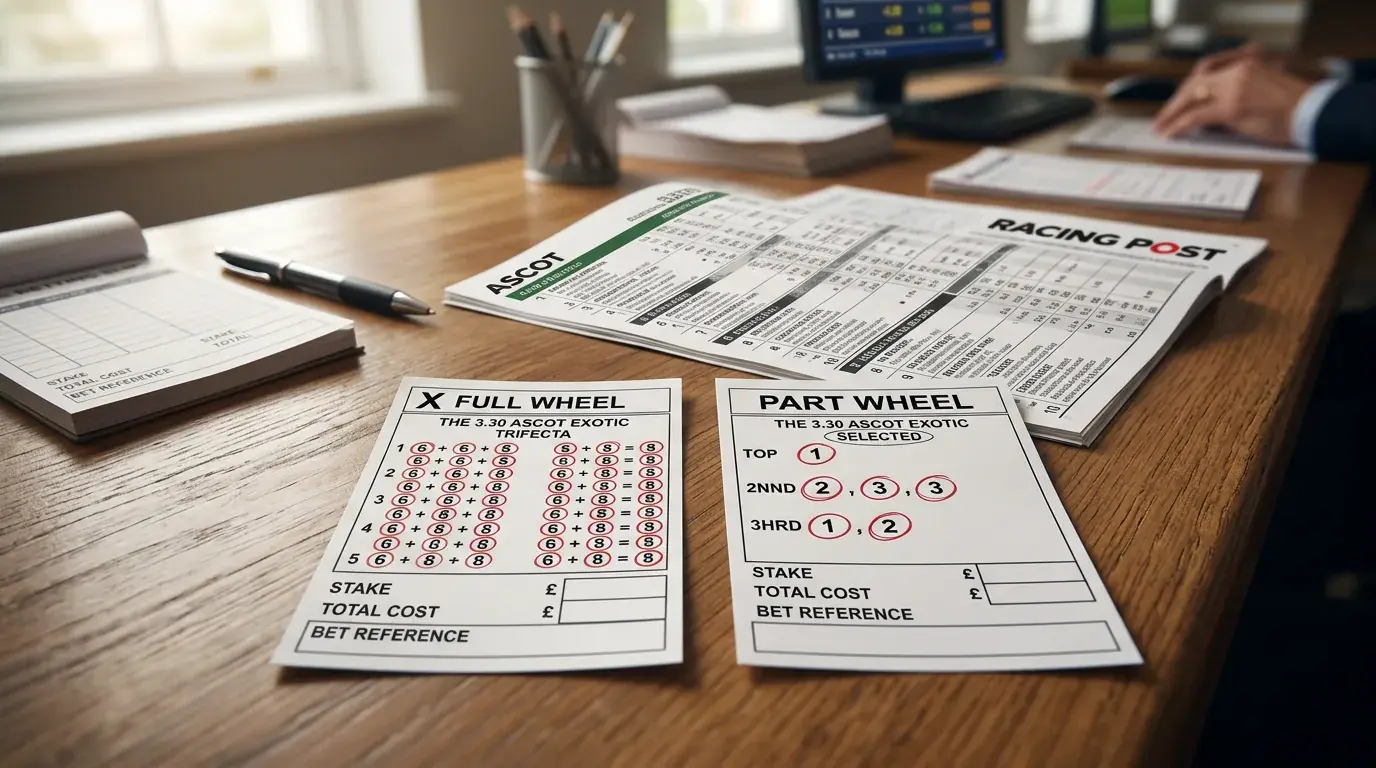
I learned the hard way that wheel bet structure matters more than most punters realise. Back in 2019, I watched a friend burn through £400 on a single Cheltenham card because he insisted on full wheels in every race. His reasoning was simple: maximum coverage equals maximum chance of winning. The mathematics said otherwise. He hit precisely zero exotic bets that day, while I walked away with a modest profit from part wheels that cost a fraction of his outlay.
The choice between full and part wheels shapes everything about your exotic betting experience. It determines your total stake, your potential return on investment, and frankly, whether you can sustain this kind of wagering over a full season. Favourites win somewhere between 30% and 35% of UK races, which means the other 65% to 70% go to horses you might not have strongly fancied. That uncertainty is precisely what makes wheel construction so critical. A full wheel gives you every possible combination involving your key horse. A part wheel lets you be selective, covering only the scenarios you genuinely believe might unfold.
Neither approach is inherently superior. Each serves different circumstances, different confidence levels, and different bankroll situations. What follows is my framework for deciding between them, built from nearly a decade of placing these bets and analysing the outcomes.
Coverage Comparison
A full wheel is exactly what it sounds like: total coverage. If you key horse number 4 to win an exacta in a 10-runner field, you get nine combinations. Horse 4 first, then horses 1, 2, 3, 5, 6, 7, 8, 9, and 10 in second place. Every possible finishing partner is covered. There is no scenario where your key horse wins and you miss the exacta because you excluded the runner-up.
The appeal is obvious. You have identified a horse you believe will win. The full wheel guarantees that if your selection analysis proves correct, you collect regardless of what finishes behind. This removes a layer of uncertainty from an already uncertain proposition. I have seen full wheels rescue bettors when complete outsiders filled the minor placings, horses that nobody would have included in a part wheel under any sensible handicapping model.
Part wheels take a different approach. Instead of covering every combination, you select specific horses to fill the remaining positions. Using that same 10-runner exacta example, you might key horse 4 to win but only wheel horses 2, 6, and 9 into second place. Three combinations instead of nine. You have decided, based on form analysis and race reading, that these three runners represent the realistic threats for the place position.
The coverage trade-off is stark. Full wheels eliminate guesswork at the cost of capital. Part wheels require more precise judgement but preserve bankroll for future opportunities. When I analyse my own betting records, part wheels outperform full wheels on a return-on-investment basis roughly seven months out of twelve. The exceptions tend to be festivals and major handicaps where field quality is compressed and results become less predictable. Those are precisely the situations where paying for full coverage sometimes makes sense.
The Cost Multiplier Effect
Here is where most bettors get themselves into trouble. They understand the coverage difference but fail to internalise how quickly costs compound, especially in trifectas and superfectas. Average flat field size in 2025 sits at 8.9 runners, down from 9.14 the previous year. Even at these reduced numbers, full wheel costs grow rapidly.
Consider a trifecta with a single key horse to win. In a 9-runner field, you are covering 8 possible second-place finishers and 7 possible third-place finishers for each of those. That is 56 combinations. At £1 per combination, your full wheel costs £56. Switch to a part wheel where you select 4 horses for second and 4 for third, and you are looking at 12 combinations for £12. The full wheel costs nearly five times as much.
The gap widens dramatically in larger fields. Premier fixtures now average 10.97 runners, the highest in recent years. A full trifecta wheel in an 11-runner race creates 90 combinations. The same part wheel structure of 4 horses each in second and third still costs just £12. You would need to believe your selection accuracy is significantly worse to justify spending 7.5 times the stake for full coverage.
This cost multiplier creates a compounding problem across a race card. Six races on an afternoon card, full wheels throughout, and you might easily stake £300 to £500 depending on field sizes. The same approach with targeted part wheels might cost £80 to £120. Both approaches hit at similar rates in my experience, but the part wheel strategy leaves capital for the following week. The full wheel approach frequently requires fresh deposits mid-month.
My rule of thumb: calculate the full wheel cost first, then ask whether the additional coverage genuinely adds value proportional to the extra stake. Usually it does not. The complete guide to wheel bet mathematics breaks down these formulas in detail for each bet type.
A Decision Framework for Your Next Exotic Bet
After hundreds of wheels across both formats, I have developed a simple decision process. Three questions determine which structure fits a given race.
First: how confident am I in my key horse? If you rate the selection as a near-certainty, full wheel coverage on the remaining positions might extract maximum value from correct analysis. If you merely fancy the horse without overwhelming conviction, part wheels let you stay involved without catastrophic exposure when the key horse disappoints. The 30% to 35% strike rate for favourites suggests that even strong selections fail more often than they succeed.
Second: how predictable are the minor placings? Competitive handicaps with evenly matched fields punish part wheel selectivity. The horses finishing second and third might come from anywhere in the field. Conditions races with clear form hierarchies reward narrower coverage because the likely place finishers are more identifiable. I default to wider coverage in handicaps and tighter part wheels in conditions stakes.
Third: what is my session bankroll? This is the most practical consideration. If your exotic budget for the day is £50, full wheels in multiple races simply is not viable. Part wheels spread that capital across more opportunities, increasing the probability that at least one bet connects. Full wheels concentrate risk, which occasionally pays handsomely but more frequently results in total wipeout.
The framework tilts toward part wheels more often than not. Full coverage earns its place in specific circumstances: small fields where the cost differential is minimal, major festival races where upset potential runs high, or situations where your key horse analysis is genuinely exceptional. Outside those parameters, part wheels offer better long-term value for sustainable exotic betting.
How much cheaper is a part wheel than a full wheel?
Part wheels typically cost 60% to 80% less than full wheels in the same race. In a 10-runner trifecta, a full wheel with one key horse creates 72 combinations, while a part wheel using 4 horses each in second and third costs just 12 combinations. The exact savings depend on how selectively you construct the part wheel, but the reduction is substantial across all bet types.
When does full wheel coverage justify the extra cost?
Full wheels make sense in three situations: small fields where cost differences are modest, major festival handicaps with genuinely unpredictable outcomes, and races where your key horse analysis is exceptionally strong. If none of these conditions apply, part wheels usually deliver better return on investment over time.
Written by the editors at Horse Racing Wheel bet.